
On May 5, 2026, a Pennsylvania-based regional bank made history — and not in a way anyone wants to.
Community Bank, a subsidiary of CB Financial Services, Inc., detected a cybersecurity incident. No hackers broke in. No ransomware encrypted the servers. No threat actor exploited a vulnerability. Bank operations continued without interruption. Customers could access their accounts. Payment systems functioned normally.
One employee used the wrong AI tool to do their job.
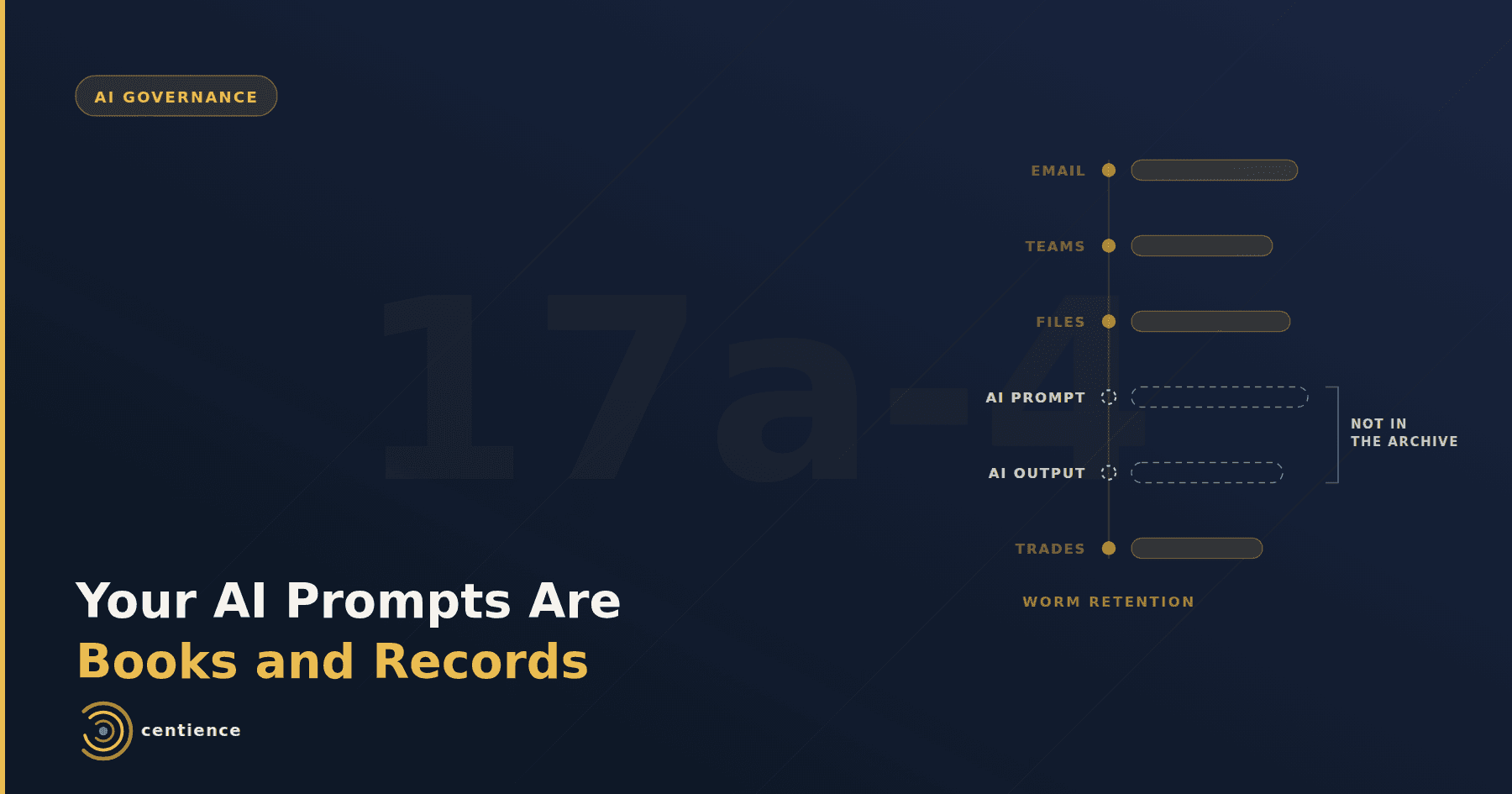
That single action — an employee processing non-public customer information through an unauthorized AI application — exposed names, Social Security numbers, and dates of birth. Six days later, CB Financial filed a Form 8-K under Item 1.05 with the SEC. According to Wilson Sonsini Goodrich & Rosati, it was the first-ever SEC cybersecurity disclosure triggered by shadow AI rather than an external attack.
> The phrase "unauthorized artificial intelligence" now appears in exactly one 8-K on record in the SEC's full-text filing database. For now.
What Shadow AI Actually Is — And Why Your Policy Won't Stop It
Shadow AI is not a new category of malware. It is not a sophisticated nation-state attack. It is your compliance analyst pasting a client's financial summary into ChatGPT the night before a board presentation. It is your operations team using an AI tool embedded in a SaaS platform that quietly added AI features in a software update — features that were on by default, that nobody reviewed, and that are now processing your data under terms of service your legal team never evaluated.
It is ungoverned AI entering your organization through the front door, carried in by well-intentioned employees who are simply trying to get their work done faster.
80%+
Workers globally
Use unapproved AI tools at work (UpGuard, 2025)
23%
Financial services employees
Shared financial statements with unauthorized AI tools (BlackFog, 2026)
57%
Healthcare respondents
Encountered or used an unauthorized AI tool at their organization (Wolters Kluwer, 2025)
1
SEC 8-K filings
Triggered by shadow AI — so far
The CB Financial filing is not an outlier. It is the first disclosure. It will not be the last.
The Financial Stakes Are Quantifiable
IBM's 2025 Cost of a Data Breach Report introduced shadow AI as a formal, material breach factor for the first time, drawing from analysis of 600 organizations breached between March 2024 and February 2025. The findings are unambiguous:
> Shadow AI breaches carry an average cost of $4.63 million, compared to $3.96 million for standard breaches — a premium of $670,000 per incident, simply because the AI tool was unsanctioned.
In financial services, the average data breach already reaches $5.56 million per incident, placing the sector second among all industries by breach cost. Shadow AI incidents push that number higher.
In healthcare, the cost is worse. The average security breach in the healthcare industry totaled over $7.4 million in 2025 — the highest of any industry, for the 14th consecutive year. Healthcare organizations operating with only 35% visibility into their AI data flows are effectively flying blind while regulators and plaintiff attorneys are watching.
The Regulatory Ratchet Is Tightening
The CB Financial filing revealed something C-suite executives across regulated industries should internalize immediately: the SEC's four-business-day disclosure clock under Item 1.05 starts at the materiality determination — not at the detection of the incident. CB Financial determined materiality on May 7 and filed on May 11. The trigger was not financial loss. The bank expressly stated the incident was not expected to have a material financial impact. The trigger was the volume and sensitivity of the exposed data.
Data sensitivity alone can compel a public SEC filing. That is a new standard.
For financial services organizations, the regulatory exposure does not stop there. Shadow AI incidents create layered exposure across the GLBA Safeguards Rule, FINRA supervisory requirements, state breach notification laws, NYDFS Part 500, and shareholder litigation risk if the board is seen to have failed in its oversight responsibilities. For broker-dealers and RIAs specifically, an undisclosed shadow AI incident touching client data is not just a technology problem — it is a supervision problem, and supervision failures carry personal liability for CCOs.
In healthcare, entering protected health information into an AI platform without a signed Business Associate Agreement is a direct HIPAA violation. Civil penalties reach $1.5 million per violation category per year. Consumer AI platforms are not designed for healthcare use and typically do not offer BAAs.
Regulators are not waiting for organizations to self-govern. The question is whether your firm will get ahead of this — or be the next filing.
Why the Policy-First Approach Is Failing
Here is the hard truth: most organizations have responded to shadow AI with the tools they know — policies, training sessions, and awareness emails.
83%
Organizations
Rely on training and awareness as their primary shadow AI response (IBM, 2025)
17%
Organizations
Have implemented technical controls to block unauthorized AI data transfers (IBM, 2025)
63%
Organizations
Lack any formal AI governance framework (ISACA, 2025)
86%
Organizations
Lack visibility into what AI tools are running in their environment
That is not governance. That is documentation. And documentation does not stop an employee from pasting client data into a free AI tool at 11 PM the night before a deadline.
The pattern is consistent across every documented shadow AI incident: the tool itself is rarely the only problem. The absence of technically enforced oversight is the problem.
Policies create paper trails. Technical controls create actual barriers.
What Technically Enforced AI Governance Looks Like
Governing shadow AI in a regulated organization requires three things working together — visibility, control, and continuity.
Visibility means knowing what AI tools are actually running in your environment — not just the ones you approved. It means understanding what data is flowing to those tools, where it is going, and whether it is covered by your data retention, privacy, and regulatory obligations. At this moment, 86% of organizations lack that visibility.
Control means technical enforcement — not acceptable use policies, but systems that can detect, classify, and restrict unauthorized AI data transfers in real time. DLP that understands the context of AI interactions. Identity-aware controls that follow the employee even when they are using a personal account on a personal device.
Continuity means this is not a one-time audit or annual review. The AI landscape changes faster than any annual assessment can track. Governance that is not continuous is governance that is already out of date.
The organizations that will survive the next wave of regulatory scrutiny are not the ones with the most comprehensive AI policy document. They are the ones whose AI governance is technically enforced and continuously managed.
The Bottom Line for C-Suite Leaders
If you are a CEO, COO, or CCO in financial services or healthcare, the CB Financial filing should matter to you personally — not as an abstract case study, but as a preview of what your organization's exposure looks like today.
The incident at Community Bank did not involve a sophisticated attacker. It did not require a systems breach. It required one employee, one unauthorized tool, and data sensitive enough that regulators considered it material.
KPMG's Q1 2026 AI Pulse Survey found that 44% of leaders cite cybersecurity and employee misuse as the hardest AI challenge they face through 2030. The regulatory expectations are only becoming more specific.
The question is not whether shadow AI is running inside your organization. Based on the data, it almost certainly is. The question is whether you have the visibility to know it, the technical controls to govern it, and the documentation to demonstrate to regulators that you took it seriously.
Find Out Where You Stand in Minutes
Centience conducts a structured AI Governance Score for regulated organizations in financial services and healthcare. Clear exposure picture. Regulatory gap analysis. A technically enforced governance roadmap — not a policy template.
---
Sources: