6 Years
FINRA 17a-4 Retention
Business communications must be immutable and readily accessible
Feb 2025
SEC Enforcement Signal
The Cyber and Emerging Technologies Unit made AI-related misconduct an explicit priority
$90M
Two Sigma Civil Penalties
Paid for failing to address known vulnerabilities in its investment models
0
What Most Firms Can Produce
The number of AI interactions the average firm can retrieve on request
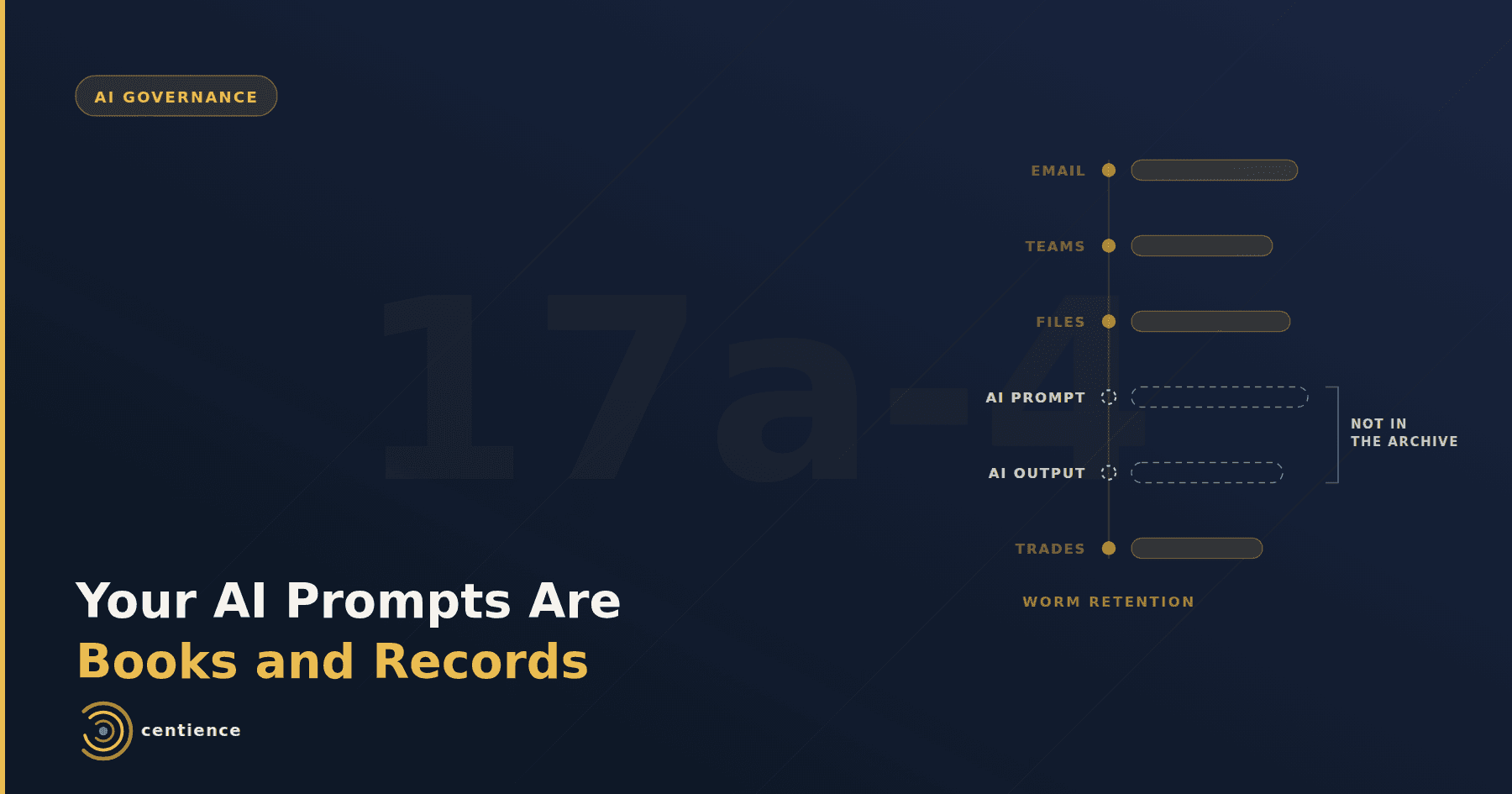
Ask a compliance officer whether their firm archives email, and the answer is immediate: yes, immutably, for six years, and they can produce it. Ask the same question about the prompts their staff typed into Microsoft Copilot or ChatGPT last quarter, and the room goes quiet.
That gap is the single most common technology-governance exposure we find in regulated firms right now. Not because anyone decided AI records did not matter — but because AI arrived inside tools firms already trusted, and nobody re-asked the recordkeeping question.
An AI prompt about firm business is a business communication
There is no AI carve-out in the records rules. FINRA Rule 4511 requires members to preserve books and records, and SEC Rule 17a-4 specifies the form: non-rewritable, non-erasable, readily accessible for the required retention period. The rules describe the *substance* of a communication, not the channel it happened to travel through.
So when an employee asks an AI assistant to draft a client email, summarize a portfolio position, or analyze a trade rationale, they have created a business communication. The prompt is an input about firm business. The output may inform advice given to a client. Both are the kind of record an examiner can ask you to produce.
⚖️ rule
Three places AI records quietly disappear
Inside the assistant, not the mailbox. When Copilot summarizes a Teams thread or drafts a document, the interaction happens in the assistant's own layer. Your email archive captures the resulting message if it is sent. It does not capture the prompt, the intermediate outputs, or the drafts that were discarded.
Through a sub-processor outside your tenant. This one surprises the most people. Some AI features route requests through model providers that sit outside your Microsoft or Google tenant. That means data leaves the boundary your other controls are built around — and the interaction log lives with a third party, on their retention schedule, not yours. Firms who assume "it is inside Microsoft, so it is inside our archive" are frequently wrong.
On tools nobody registered. Employees adopt AI faster than committees approve it. A consumer ChatGPT account used for a client memo produces records your firm has no visibility into and no ability to retain.
What "produce the audit trail" actually means
If an examiner asks how your firm supervises AI use, a policy document is the beginning of the answer, not the end. A defensible response can produce, on request:
That is the same standard email archiving has met for two decades. The difference is that most firms have never applied it to AI.
The supervision problem beneath the records problem
Records and supervision are the same failure wearing different clothes. FINRA Rule 3110 requires a supervisory system reasonably designed to achieve compliance. If AI tools are in use and the firm cannot see what is being submitted to them, the supervisory system is not reasonably designed — not because AI is inherently risky, but because the firm has no visibility into a channel where business is being conducted.
The SEC's creation of its Cyber and Emerging Technologies Unit in February 2025 made AI-related misconduct an explicit enforcement priority. And the Two Sigma matter — $90 million in civil penalties for failing to address known vulnerabilities in its investment models — is a useful reminder of the pattern regulators punish: not the existence of a technology problem, but the failure to act on one the firm already knew about.
✅ action
Do not commit to more monitoring than you will actually operate
One caution that experienced compliance officers raise immediately, and they are right: be careful what your policy promises.
Examiners write findings when a firm commits to a procedure and then does not follow it. A policy that pledges comprehensive AI monitoring the firm cannot sustain creates an examinable obligation where none existed. The better approach is to scope deliberately — state exactly which tools are approved, which channels are captured, what is retained and for how long — and then be able to prove that narrower commitment completely.
Precision beats ambition here. A tightly scoped program you operate continuously is far more defensible than a broad one you aspire to.
What a defensible AI recordkeeping program looks like
Note the order. Firms tend to start with the policy because it is the easiest artifact to produce. Examiners start with the evidence.
The question worth answering before someone else asks it
If a request letter arrived next week asking your firm to produce every AI interaction touching client information for the past twelve months, could you?
For most regulated firms today the honest answer is no — and that is not a failure of diligence so much as a control that has not caught up to a tool that arrived quietly. The firms that close this gap in 2026 will be the ones that treated AI as a records and supervision question early, rather than a technology question later.
The Centience Governance Score is a free, five-minute self-assessment that scores your firm 0–100 across cybersecurity, data and records, supervision, infrastructure, and AI governance — and shows you exactly where your AI recordkeeping stands before an examiner does.
Get Your Free Governance Score
🔗 Related Service: AI Governance
Policy, tool inventory, staff attestation, shadow-AI detection, and retained AI audit trails — operated continuously as part of one accountable program.
For the records foundation underneath this, see our guide to data governance and FINRA 17a-4 retention, or how Centience supports financial services firms specifically.

Frequently Asked Questions