73%
Law Firms Using AI Tools
Without formal data governance policy (Thomson Reuters 2025)
$3.5M
Average Cost of Law Firm Data Breach
Including regulatory and reputational consequences
Rule 1.6
ABA Confidentiality Obligation
Applies to all client data regardless of technology used
48 States
Have Issued AI Ethics Guidance
Covering attorney use of AI with client information
Law firms are data custodians by profession. Every client engagement creates a data record — privileged communications, work product, confidential client information, financial data, sensitive business strategy. The professional responsibility rules that govern how attorneys handle that information have existed for decades. The data governance infrastructure to enforce those rules technically has not.
In 2026, the gap between the obligation and the infrastructure is closing — because it has to. AI tools have made the gap visible in a way that paper files and siloed email archives never did. When an attorney pastes a confidential client memo into an AI drafting tool, the question of where that data went, how long it was retained, and who can access it can no longer be answered by pointing to a filing cabinet.
Law firm data governance is not an IT compliance project. It is the technical layer that makes your professional responsibility obligations enforceable in a digital and AI-enabled environment.
ABA Model Rule 1.6: The Foundation of Law Firm Data Governance
ABA Model Rule 1.6 prohibits attorneys from revealing information relating to the representation of a client without informed consent, except in narrowly defined circumstances. The rule applies to all information relating to representation — not just information marked confidential, not just attorney-client privileged communications, not just information the client specifically asked the attorney to protect.
Comment 18 to Rule 1.6, added in 2012 and expanded in subsequent guidance, addresses technology directly: lawyers must take reasonable precautions to prevent unauthorized access to client information when using technology. The test is reasonable precautions — which means the standard evolves as technology evolves.
⚖️ Rule
The practical implication is direct: an attorney who uses an AI tool to draft a brief, review a contract, or summarize deposition transcripts has a professional responsibility obligation to understand the data governance of that tool. Where does the client information go? Is it retained by the vendor? Is it used to train the model? Who at the vendor has access?
These are not rhetorical questions. They are the questions a state bar disciplinary proceeding or a legal malpractice claim will ask. A law firm data governance program gives attorneys documented, defensible answers.
Matter-Centric Data Classification: The Structure Law Firms Need
General enterprise data classification — restricted, confidential, internal, public — provides the framework. Law firms require a classification structure that maps to the legal concepts that govern their data handling obligations.
Privileged — Attorney-Client
Communications between attorney and client made for the purpose of seeking or providing legal advice. Protected from compelled disclosure in litigation. The highest-sensitivity classification in law firm data. AI tools that process privileged communications require the most rigorous vendor evaluation and data handling controls.
Work Product
Documents and tangible things prepared by or for an attorney in anticipation of litigation. Protected under FRCP 26(b)(3) and state equivalents. Opinion work product — an attorney's mental impressions, conclusions, opinions, and legal theories — receives near-absolute protection. Classification must distinguish fact work product from opinion work product for access control purposes.
Confidential — Client
Client information that is not privileged but is confidential under Rule 1.6 — business strategy, financial information, personal details, operational data. Broad category covering most non-communication matter data.
Internal — Firm
Administrative records, billing data, HR records, firm strategy. Subject to standard data governance requirements but not client-specific professional responsibility rules.
The classification must be applied at the matter level, not just the firm level. A document in a real estate transaction matter has different confidentiality and privilege implications than a superficially similar document in a litigation matter. Data governance for law firms must integrate with matter management — the classification of a record is determined by the matter it belongs to, not just the content of the document itself.
Most law firm document management systems have classification fields. Most are not consistently populated. A data governance program establishes the policy for classification, trains timekeepers and staff on application, and audits the classification of active matter data on a defined schedule.
The AI Problem: What Happens When Privileged Data Enters an AI Tool
The state bar guidance that has emerged across 48 jurisdictions on attorney AI use converges on a common concern: attorneys are using AI tools with client information without understanding what those tools do with the data. The concern is not theoretical. It reflects what is actually happening in law firms right now.
The specific risks that state bar opinions have identified:
Training data exposure. Many consumer AI platforms, unless specifically configured otherwise, use submitted content to improve their models. A client memo submitted to a consumer AI tool may become part of the training data that improves responses for future users. That disclosure is a Rule 1.6 violation.
Vendor employee access. AI platform vendors typically retain the right to have employees review submitted content for safety, quality assurance, and abuse prevention. The contractual right of a vendor employee to review a privileged client communication is a potential waiver issue and a clear Rule 1.6 concern.
Jurisdictional data storage. Client data submitted to cloud-based AI tools is stored in data centers whose location and governing law may not be known to the attorney. Certain jurisdictions impose restrictions on data residency for specific types of sensitive information.
Retention without consent. AI platforms vary significantly in how long they retain submitted data. Data submitted for a draft brief may remain accessible in an AI platform's logs long after the engagement has ended and the matter file has been closed.
⚠️ Warning
A law firm data governance program that addresses AI must include a vendor evaluation framework specifically designed for the legal context — covering data retention, training data opt-out provisions, employee access controls, data residency, and contractual protections that go beyond standard enterprise vendor agreements.
Client File Retention: The Obligation Most Firms Underestimate
Attorney retention obligations for client files are established by state bar rules, court rules, and engagement agreements — and they vary significantly by jurisdiction and matter type. What most law firms underestimate is how much client file retention has changed as client data has moved from physical files to digital systems distributed across document management, email, collaboration platforms, and now AI tools.
State bar requirements for client file retention typically range from five to ten years after matter closure, with some jurisdictions requiring permanent retention for certain matter types (estate planning documents, real property records, criminal defense files). The requirement is to retain the file — which in a digital environment means all matter-related documents, communications, and increasingly, AI-generated work product created during the engagement.
The practical data governance requirements for law firm retention:
Matter closure process — a defined process that identifies all data locations for a matter at closing, confirms the classification and retention period for each record type, and moves matter data into a retention-compliant archive.
Email and communication capture — attorney work email that discusses client matters is part of the client file. The current explosion of collaboration platform usage — Teams, Slack, client portal communications — expands the communications scope that must be retained.
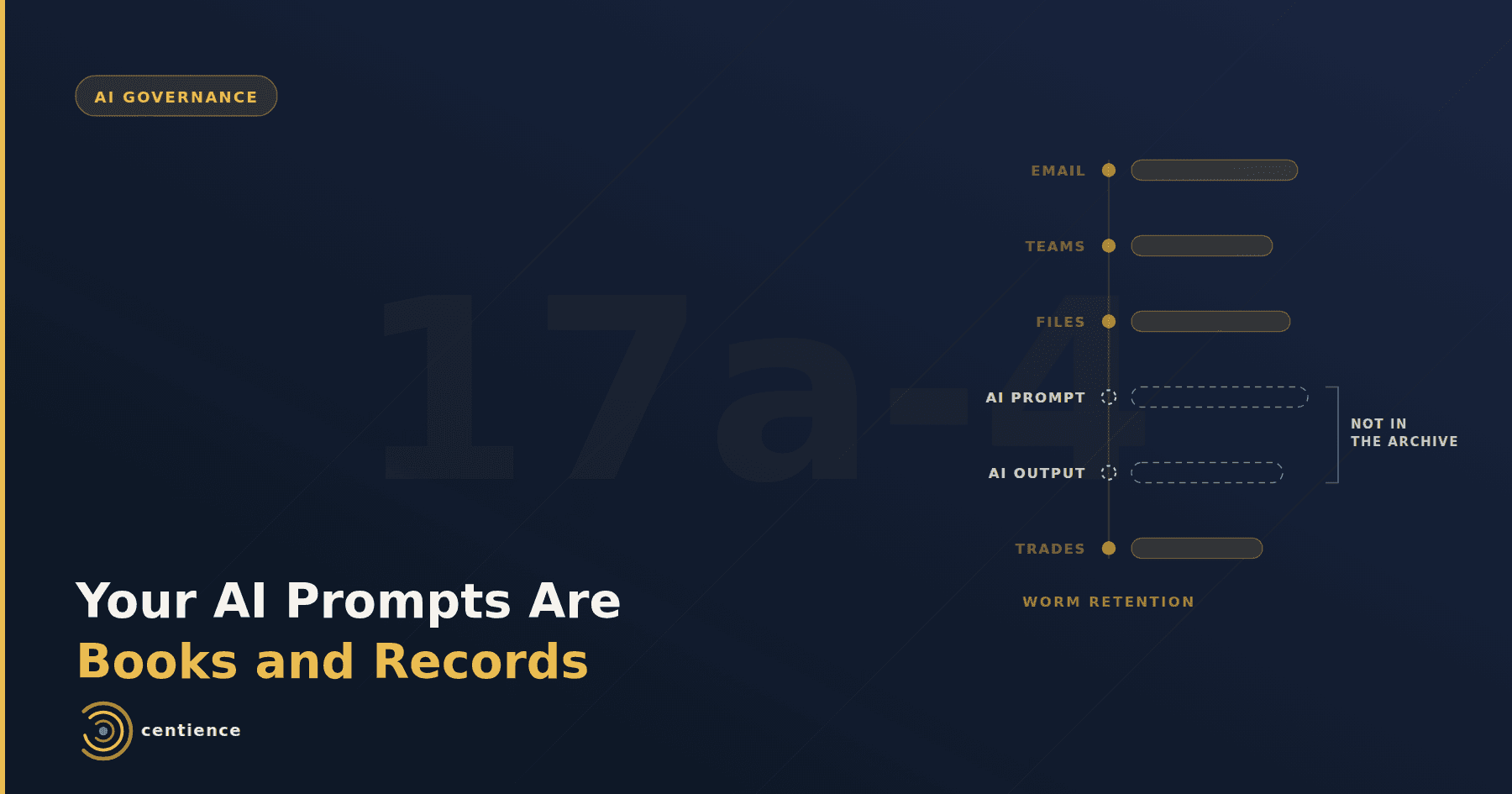
AI output preservation — AI-generated drafts, AI-assisted research summaries, and AI-generated communications used in a matter are matter records subject to retention. The question of whether an AI output is a record has been answered by most state bars: if it was used in the representation, it is a record.
Destruction protocols — records must be destroyed at the end of the retention period in a manner that prevents reconstruction of client confidential information. Data governance must define destruction protocols for each data tier and document destruction for records with elevated privilege sensitivity.
Access Control Governance: Privilege Is Not Enforced by Labeling
A document marked "PRIVILEGED AND CONFIDENTIAL" is only as protected as the access controls on the system where it lives. In most law firms, access control is managed through a combination of document management system permissions, email group access, and informal practices — applied at the timekeeper level but rarely reviewed or audited after initial setup.
The access control failures that generate the most significant data governance consequences in law firms:
Cross-matter contamination. Partners and associates with access to a client matter in document management systems may, by virtue of legacy permissions, have access to other client matters for which they have no work. The conflict of interest implications of unauthorized access to adverse party information are significant.
Former employee access. Attorney departures and staff turnover are common. Access revocation at departure is frequently handled inconsistently — particularly for cloud-based systems that were provisioned outside the IT department's visibility.
Opposing counsel data access. Electronic discovery exchanges create temporary data access arrangements that must be tracked, documented, and terminated when the matter closes. Data governance must include a protocol for managing matter-specific data sharing with external parties.
AI vendor access. As discussed above, vendor employees may have contractual access to data submitted to AI tools. This is not standard IT vendor access — it is a potential disclosure of privileged information that must be evaluated before the tool is deployed.
✅ Action
Data Lineage for Legal Work: AI Audit Trails in Litigation and Regulatory Context
The emergence of AI-generated legal work product creates a new dimension of data lineage obligation that law firms have not previously encountered. Two specific contexts where AI data lineage is now required:
Litigation discovery. Courts are beginning to address the discoverability of AI-generated work product and the metadata associated with AI tool use. A 2025 decision in the Southern District of New York required a law firm to disclose in a discovery response that certain documents had been drafted with AI assistance and to produce the AI interaction logs associated with those drafts on the grounds that they reflected the research methodology used. The holding is not universal, but it signals a direction. Law firms that cannot produce AI interaction logs because they were never captured are in a different position than firms that can produce them and assert work product protection.
Regulatory investigations. Law firms that represent clients in regulatory matters — securities enforcement, HIPAA investigations, antitrust reviews — may themselves become subjects of government information requests. A request for "all communications and documents relating to [matter]" that a firm cannot fully respond to because AI-generated content was not captured in the matter file is a compliance failure with both professional responsibility and regulatory implications.
Data lineage for law firms using AI means: capturing what data was submitted to an AI tool, what output was generated, whether the output was used in the matter, and what happened to both the input and the output after the interaction.
🔗 Related Service: Data Governance Program
Centience builds matter-centric data governance programs for law firms — classification aligned to privilege and confidentiality obligations, AI vendor evaluation, retention aligned to bar rules, and access control governance.
What a Law Firm Data Governance Program Requires
A defensible law firm data governance program has six components:
Matter-centric classification policy — a written policy that defines privilege, work product, confidential, and internal classifications in terms of legal concepts, not just sensitivity levels, and establishes how classification applies to different record types within a matter.
AI vendor evaluation framework — a structured process for evaluating AI tools before deployment, covering data retention, training data practices, employee access provisions, data residency, and contractual protections. No AI tool that processes client information should be deployed without completing this evaluation.
Retention schedule by matter type — a retention schedule that maps state bar requirements, applicable court rules, and engagement agreement provisions to specific retention periods for different matter types and record categories.
Access control governance — periodic reviews of matter access permissions, a documented departure process that includes access revocation, and a protocol for managing external data sharing in litigation matters.
AI output preservation — a mechanism for capturing AI interaction logs and AI-generated work product as matter records, with retention aligned to the matter type's retention schedule.
Destruction protocols — documented processes for secure destruction of client records at retention expiration, with specific protocols for records in the privileged and work product classification tiers.
The firms that build this infrastructure do not do it because they expect to be audited — they do it because the alternative is operating an AI-enabled practice on a data governance foundation designed for paper files.
🔗 Related Service: AI Governance Program
AI governance at Centience is built on the data governance foundation — AI tools that process privileged client information require more rigorous vendor evaluation and oversight than general enterprise AI deployment.

Frequently Asked Questions